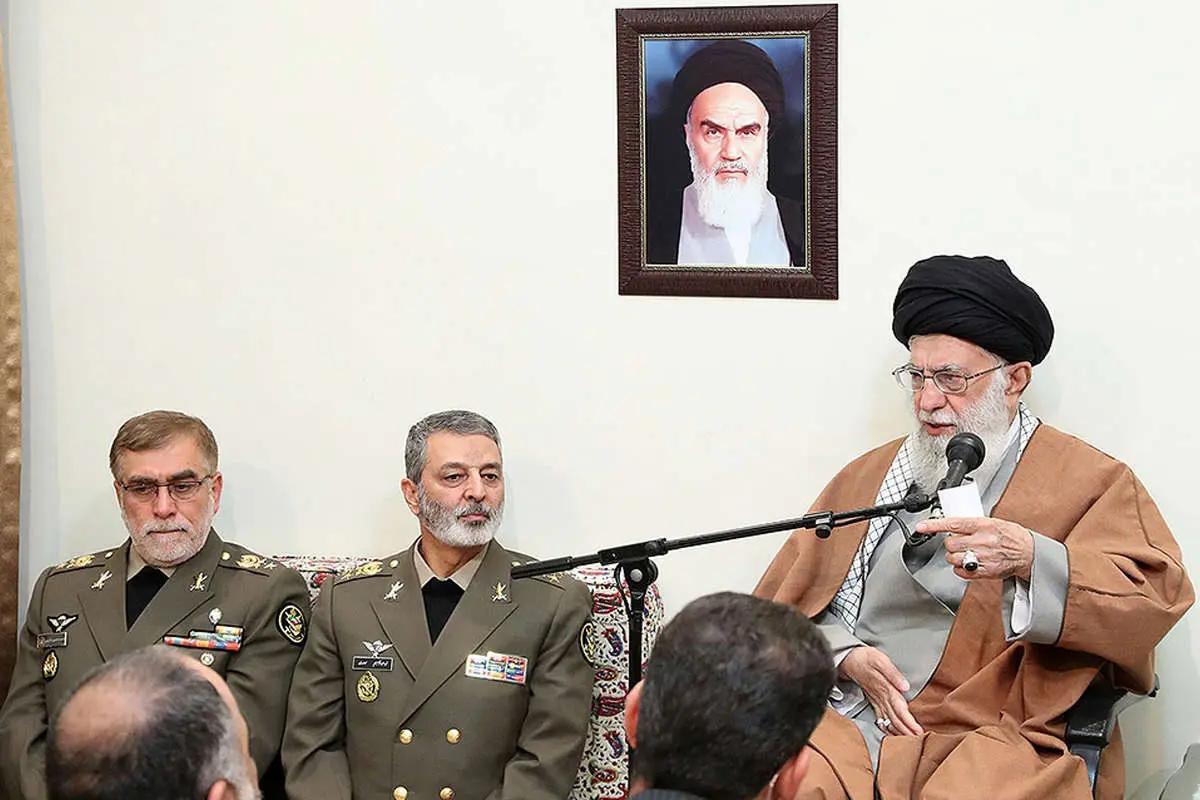
Sardar Mohammad Shirazi, head of the military office of Ayatollah Ali Khamenei, is one of the least known figures to the general public – yet also one of the most influential within the security-ideological system of the Islamic Republic. His rank – Brigadier General in the Basij Force – reflects his roots in the ideological arm of the Revolutionary Guards.
For more than three and a half decades, he has served as the Supreme Leader’s military “eyes and ears”: filtering reports, disseminating orders, supervising policy implementation, and coordinating between the various military bodies – the Revolutionary Guards (IRGC), the regular army (Artesh), and the Basij.
Unlike prominent commanders such as Hossein Salami or Esmail Qaani, Shirazi operates mainly behind the scenes.
He is not the “star”; he is not even mentioned on U.S. sanctions lists targeting Iran’s Revolutionary Guards, as he is not defined as an operational figure. Yet in practice, he is the “silent pillar” that upholds Khamenei’s military-ideological axis. His statements in official media are relatively rare, but when made, they precisely reflect Khamenei’s and the IRGC’s official line. His voice is that of pure military-revolutionary ideology, with no compromises.
The work of the military office in the Supreme Leader’s compound (“Beit-e Rahbari”) in Tehran:
The office does not directly command forces like the General Staff or Khatam al-Anbiya Headquarters; rather, it serves as the Supreme Leader’s personal mechanism for control, supervision, and coordination over the military and security apparatus. Its core functions include:
- Direct and secure communication between Khamenei and the commanders of the armed forces.
- Conveying the Supreme Leader’s personal orders to senior commanders – especially on sensitive issues (nuclear, missiles, Quds Force, regional interventions, emergency situations).
- Ideological-political supervision of the military – ensuring the forces remain loyal to the principle of Velayat-e Faqih and do not drift toward “secular professionalism” or excessive independence.
- Managing relations with the Supreme Leader’s representatives stationed in all branches of the military, the Guards, air force, navy, etc.
- Handling special matters – for example: senior appointments, dismissals, promotions, secret budgets, the nuclear and missile projects, responses to crises (such as Israeli or American attacks).
- Coordination with other offices in the House (intelligence office, security office, foreign affairs office) on military-political issues.
- Monitoring loyalty – identifying signs of “deviation” or disloyalty among senior officers.
The military office is the “red line” – the most private, secure, and reliable channel through which Khamenei actually controls the army and the Revolutionary Guards, beyond the official staff structures (General Staff, Supreme National Security Council, etc.). In emergency situations, the office monitors, advises, and transmits direct orders from the Leader to the headquarters, becoming Khamenei’s strategic command center.
It is almost the sole channel for communication with the head of Khatam al-Anbiya Headquarters – the top military commander in emergencies – and the branch commanders, since Khamenei sometimes moves between an underground bunker and his office and reduces the use of electronic communications.
The Shirazi brothers:
His brother is Hojjat al-Islam Ali Shirazi, who serves as head of the “Aqidati-Political Organization” of the Law Enforcement Forces (Faraja), or – according to some sources – deputy head of the Aqidati-Political Organization of the Ministry of Defense. His role includes ideological supervision, political-religious guidance, preserving “ideological purity,” and embedding the Supreme Leader’s lines within the police and internal security forces.The Shirazi brothers are a classic example of a long-term personal circle of trust around Khamenei – a bond forged even before the Islamic Revolution (1960s and 1970s), during Khamenei’s period of exile/migration to Rafsanjan and Iran-Shahr (Kerman province).
The brothers visited him there, and the connection became one of the most reliable over decades, with Mohammad Shirazi becoming the primary “military conduit” and Ali Shirazi the “internal ideological-security conduit” responsible for instilling revolutionary ideology and ensuring loyalty within the police forces and parts of the Ministry of Defense.
The Shirazi brothers serve as Khamenei’s dual “gatekeepers” – one in the military, one in internal security – making them together a highly valuable personal-strategic asset to the Supreme Leader. This explains why harm to one of them – and especially a hypothetical assassination of Mohammad – would be perceived as a direct blow to his innermost circle.
Existential enemies: “The Great Satan” and “the cancerous tumor”:
In Mohammad Shirazi’s view, the United States is “the Great Satan” waging a multi-dimensional war – cultural, economic, media, and military – against the Islamic Revolution. He repeatedly praises Iran’s technological progress: precision missiles, advanced drones, radar systems, and air defense capabilities that have “shattered the illusion of American superiority.”
The 2020 attack on Ain al-Asad base in Iraq, he says, proved Iran’s ability to directly strike American interests – and to deter.Israel, or “the Zionist regime” in his terminology, is a “cancerous tumor” that must be eradicated. Shirazi fully supports Khamenei’s line: backing the “Axis of Resistance” – Hezbollah, Hamas, the Houthis, and the militias in Iraq – as part of a strategic struggle against Israel.
He presented the Iranian attack in April 2024 (hundreds of missiles and drones toward Israel, in response to the bombing of the consulate in Syria) as proof of effective deterrence: “The Zionist regime is weaker than it appears, and Iran is stronger than ever.”The conflict, in his eyes, is not merely military – it is ideological-global. The U.S. and Israel operate together as partners in a conspiracy against revolutionary Islam.
The solution: active deterrence, high readiness, tight intelligence cooperation between the IRGC and general intelligence (MOIS), and an uncompromising revolutionary spirit.Shirazi does not call for a preemptive attack. The policy he represents is defensive-deterrent: “Iran will not initiate war, but will respond firmly and decisively to any aggression.” “We can” – the slogan of military self-reliance – recurs again and again in his speeches. He emphasizes readiness, coordination, and absolute obedience to Khamenei’s directives, not personal initiative or adventurism.
Military secretary or regime chief of staff?
Shirazi’s role bears great similarity to that of the military secretary of Israel’s Prime Minister: a direct channel of trust, unrestricted access to sensitive information, filtering of reports, coordination between bodies, and recommendations to the leader.
The essential difference – Khamenei is a theocratic Supreme Leader who directly controls the military, so Shirazi’s status is more “supreme” and permanent.
A closer comparison in genre: Fouad Shukr, Hassan Nasrallah’s military chief of staff in Hezbollah. Both operate in the shadows, personally close to the leader for decades; they are the ones who ensure he receives a reliable, complete, and synchronized military picture and have long been considered the operational-strategic “brains” behind the scenes.
The 2024 assassination of Shukr significantly weakened Hezbollah; the assassination of Shirazi could be a severe blow to Khamenei – a personal injury, temporary but critical disruption in military coordination in the face of a military strike, though not necessarily an “existential undermining,” since the Iranian system is built on continuity and layers of protection.