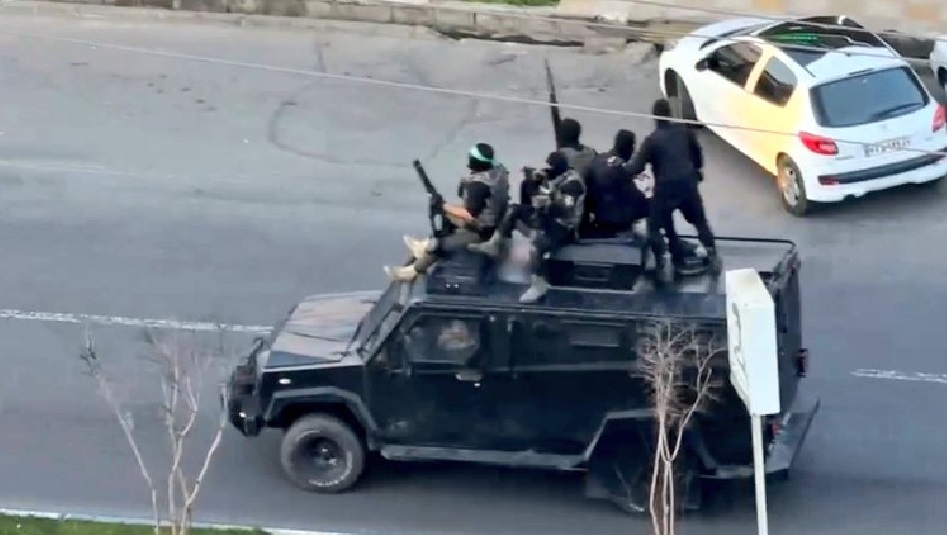
Documentation from the military lockdown imposed by the regime on the streets of Iran reveals for the first time the presence of foreign Shia mercenaries (Iraqi). The documentation, which surfaced on a Telegram channel affiliated with the Revolutionary Guards, is primarily intended as a consciousness operation aimed at highlighting the suppression of protests, but it also attempts to evoke trauma on the Israeli side, as it recalls the failure of October 7.
The photograph marks a significant turning point in reports on the widespread protests in Iran in January 2026: this is the first time direct and detailed visual documentation has been published indicating the actual presence of Iraqi Shia militia fighters on Iranian soil, with the aim of assisting the regime in suppressing civilians.The image, apparently taken in early January 2026 (around January 2–6) and documenting a black armored off-road vehicle (resembling a military G-Class) moving through the streets of an Iranian city, shows a large group of armed men on its roof, wearing dark uniforms, green keffiyehs or headscarves, armed with assault rifles, and presenting an organized and menacing appearance.
The “Intelli Times” analysis clearly identifies the characteristics as belonging to factions of Al-Hashd al-Shaabi (Popular Mobilization Forces – PMF), and in particular to Kata’ib Hezbollah and other special units directly controlled by the Quds Force of the Iranian Revolutionary Guards.The main identifying characteristics revealed by the analysis:
- Dark, uniform, and professional uniforms – a style typical of Iraqi militias, in contrast to the uniforms of the Basij or Iranian Revolutionary Guards (which often incorporate green-gray or civilian clothing).
- Green keffiyehs and headscarves – a clear symbol of Hezbollah (both Iraqi and Lebanese) and all pro-Iranian Shia militias.
- Black armored vehicle with numerous fighters on the roof – a classic tactic of Hashd al-Shaabi units in urban areas, intended to demonstrate power and spread fear.
- Fast and open movement – in contrast to local Iranian forces, which usually operate in a more concealed and orderly manner.
According to parallel reports from sources such as Iran International (dated January 7, 2026) and Iraqi sources, approximately 800 Iraqi fighters – most of them from Kata’ib Hezbollah, Harakat al-Nujaba, Sayyid al-Shuhada, and the Badr Organization – entered Iran starting January 2 through southern border crossings (Shalamcheh, Chazabeh, Khosravi). They posed as pilgrims (ziyarah) to Mashhad, gathered at bases in Ahvaz (Khuzestan), and from there were dispersed to major cities to reinforce local forces.
The main reason for using foreign forces, as noted in the “Intelli Times” analysis, is a shortage of manpower amid the dispersal of demonstrations and even the growing distrust of the regime in its own forces: police, Basij, and even parts of the Revolutionary Guards refuse to shoot at unarmed Iranian masses – women, students, and ordinary citizens – forcing the regime to “import” foreign mercenaries.Later reports (from January 8 to 12) include additional confirmations of Hashd involvement, and photos and videos from places like Shahrekord show particularly heavy suppression – apparently with the participation of those same forces.
This report aligns with multiple credible sources from early-to-mid January 2026, including Iran International, Western think tanks, and international media, confirming the deployment of around 800 Iraqi Shia militia fighters (primarily from Kata’ib Hezbollah and similar groups) to assist in the crackdown on the ongoing nationwide protests.